
Why use ceramic bushings
Bushings and sleeves live on friction: they run in permanent contact with the shaft, often bathed in fluids loaded with abrasive solids. In a metal part, that contact opens clearance — and clearance becomes vibration, misalignment, seal leakage and, eventually, equipment shutdown. The replacement cycle repeats at every maintenance stop.
Technical ceramics break that cycle: at 9 Mohs hardness (above 1,300 HV), the bushing surface barely wears, and the low roughness of CT CEDUR alumina reduces friction against the shaft. The result is stable clearance, less vibration and a much longer maintenance interval.
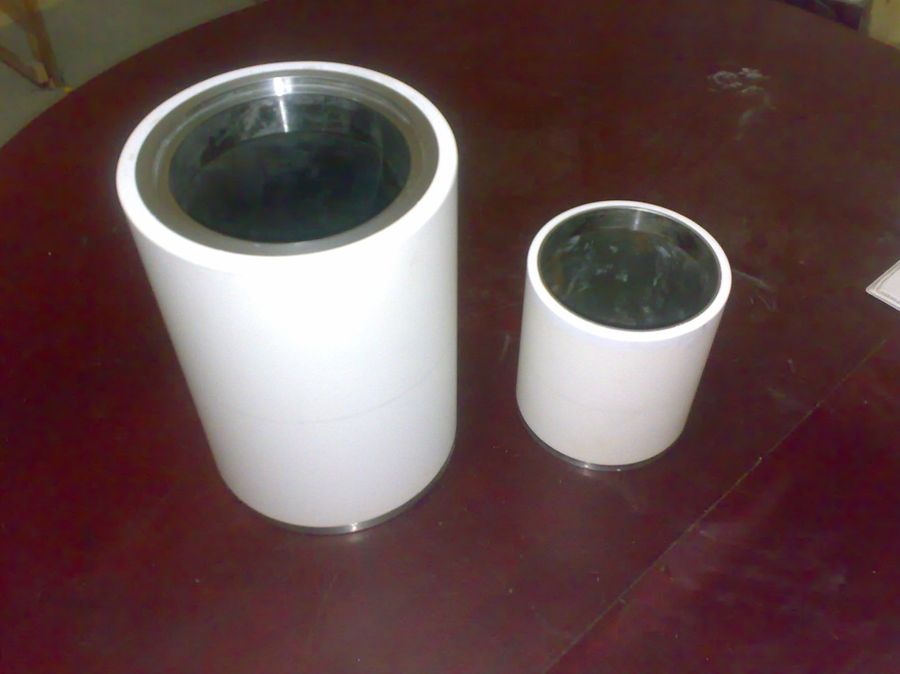
What we supply
- Pump bushings — protection of the friction points of slurry and process pumps.
- Shaft sleeves — the wear surface becomes ceramic, preserving the metal shaft.
- Bearing bushings — stable clearance and less vibration in continuous rotation.
- Lined bushings — metal body combined with a ceramic running surface, as the design requires.
- Custom parts — geometries and dimensions produced from your drawing or a used part.
Dimensional precision: grinding and tolerances
A bushing is a fitted part: without dimensional precision there is no performance. After sintering above 1,600 °C, every CETARCH bushing is precision ground to tight design tolerances, ensuring a perfect fit and predictable behaviour at assembly — with hardness, density and absorption testing validating each formulation.
Where it is applied
- Slurry pumps — bushings and sleeves at the friction points of the rotating assembly.
- Mining — rotating equipment in contact with abrasive slurry.
- Chemical, pulp & paper and energy — shafts and bearings in corrosive or solids-laden fluids.
How we develop your bushing
- Diagnosis — analysis of the friction point, the fluid in contact and the operating conditions.
- Engineering — dimensions, tolerances and ceramic formulation defined from the drawing or the used part.
- Manufacturing — forming, sintering in in-house kilns and precision grinding.
- Application — delivery, installation support and field performance follow-up.
Frequently asked questions
Can ceramic withstand the continuous friction of a shaft?
Yes — that is exactly where it excels. With near-diamond hardness and a low-roughness surface, a ceramic bushing barely wears in continuous contact, keeping the design clearance far longer than a metal part.
To what tolerances are the bushings made?
Bushings are ground after sintering to the tight tolerances defined in the design — the same dimensional-precision process used across the CETARCH line, ensuring a perfect fit and predictable performance in every assembly.
Which ceramic formulation should my bushing use?
For friction with abrasion, CT CEDUR 94HH or 96HH; for thin parts, complex geometries or contact with aggressive chemicals, the high-purity 99HH is indicated. CETARCH engineering specifies the formulation from an analysis of the application.