Grinding: continuous wear and contamination risk
In grinding, the working surface is in permanent friction with abrasive material — there is no intermittent duty to give the part relief. Metal rollers continuously lose diameter and profile, and every microgram of worn metal ends up inside the ground product: in sensitive processes such as glazes, frits and chemical formulations, that iron contamination changes the colour and behaviour of the final product.
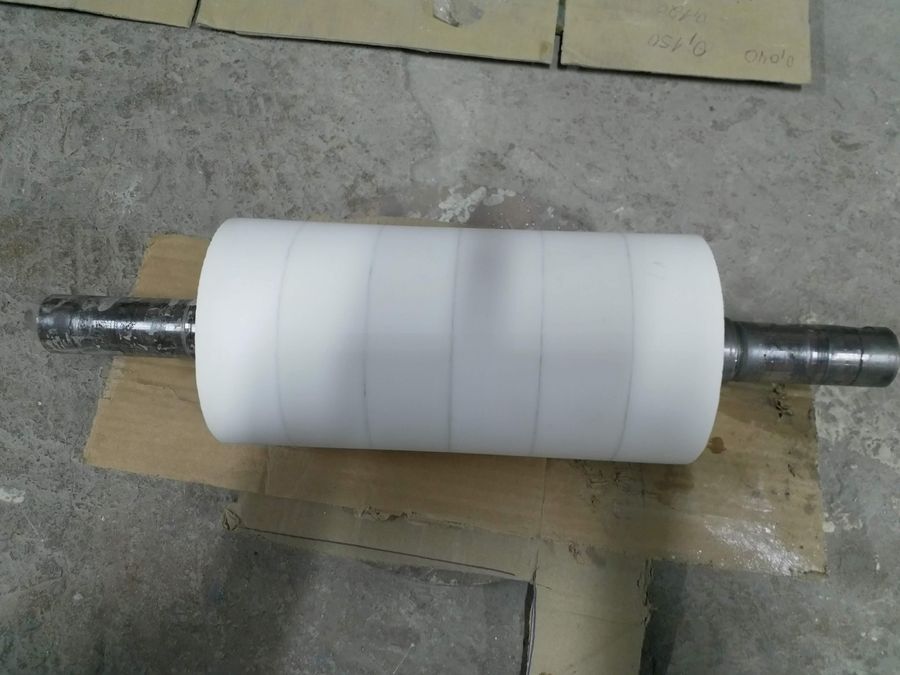
A ceramic roller solves both problems at once: the hardness of CT CEDUR alumina (9 Mohs, above 1,300 HV) virtually eliminates diameter loss, and the material's chemical inertness guarantees nothing is transferred to the product — no corrosion, no contamination of the processed material.
What we supply
- Ceramic grinding rollers — in high-hardness alumina, to your mill's dimensions.
- Ceramic cylinders — for grinding and forming processes where wear is continuous.
- Insulating bases for electrostatic filters — ceramic combines electrical insulation and mechanical strength in one component.
- Linings for the grinding circuit — together with the wear-resistant lining line.
- Custom parts — diameters, lengths and mountings defined by engineering from your drawing or a reference part.
Material: CT CEDUR alumina
The rollers are sintered above 1,600 °C, virtually free of glassy phase, with nanoparticles built into the formulation. For continuous-abrasion grinding, CT CEDUR 94HH and 96HH are the usual picks; where product purity is critical, the 99HH (99.5-99.7% Al₂O₃) — see the full table under alumina ceramics.
Where it is applied
- Cement — raw-meal and coke grinding, where wear is continuous and volumes are high.
- Ceramics & glass — grinding glazes, frits and raw materials without iron contamination.
- Chemical and agribusiness — grinding sensitive formulations and abrasive products.
How we develop your roller
- Diagnosis — analysis of the ground material, the mill duty and the wear point.
- Engineering — dimensions, mounting and ceramic formulation defined for your equipment.
- Manufacturing — forming, sintering in in-house kilns and precision grinding of the diameter.
- Application — delivery, installation support and field performance follow-up.
Frequently asked questions
Does a ceramic roller contaminate the ground material?
No — that is one of the main reasons to use it. Alumina is chemically inert and loses virtually no mass to wear, so nothing is transferred to the product. With metal, the worn roller material ends up incorporated into whatever is being ground.
Does a ceramic roller keep its calibrated diameter?
Yes. With hardness above 1,300 HV, diameter loss is minimal even in continuous grinding — the roller leaves precision grinding with tight tolerances and keeps its working profile throughout its service life, preserving the process particle size.
Can you build rollers for any mill?
The design is custom: diameter, length and mounting follow your mill's drawing or a reference part. CETARCH engineering defines the CT CEDUR formulation suited to the ground material and the operating duty.