Wear in steelmaking
In a steel plant, wear comes as a pair: abrasive particles and heat. Ore fines, sinter and pellets run in continuous flow through ducts, chutes, branches and pneumatic conveying systems — and process temperature accelerates the degradation of metal plates and alloys. The result is holed elbows, deformed profiles and component replacements repeating every campaign.
Technical alumina performs well in exactly that combination: it retains mechanical properties at high service temperatures and barely wears under abrasion, with hardness above 1,300 HV. A wear-resistant ceramic lining multiplies component life by up to 10× versus Ni-Hard.
Where ceramics are applied in steelmaking
- Sinter — ducts, chutes and sinter-fines handling points, where hot abrasion is continuous.
- Pelletizing — conveying and classification of iron-ore pellets and fines.
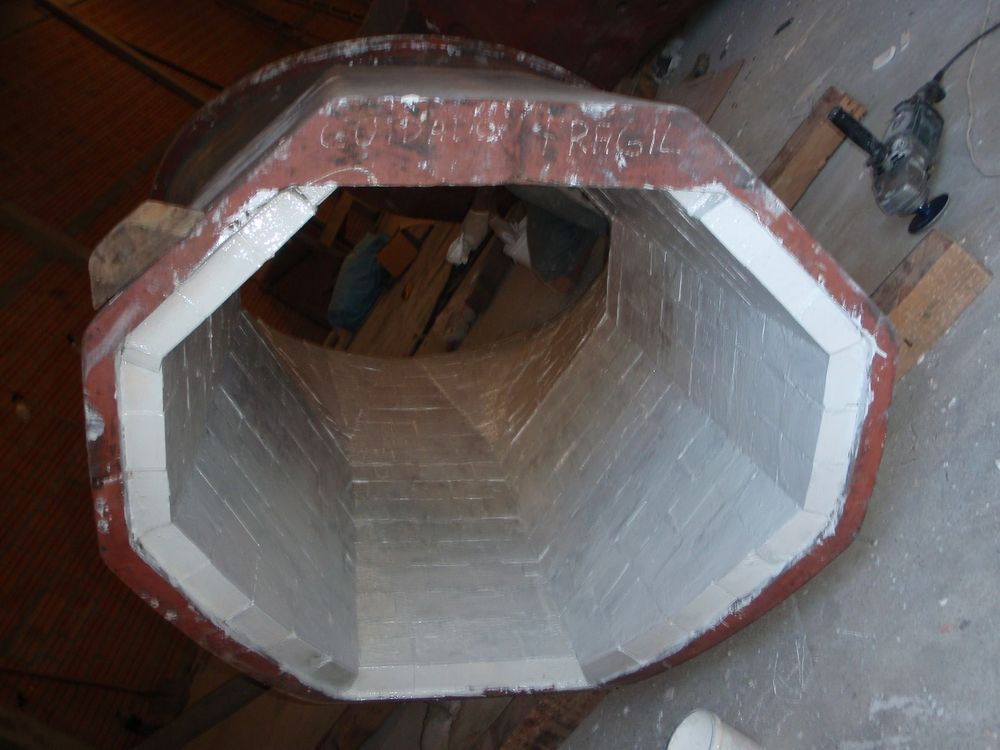
- Pneumatic conveying of fines — lined pipes, elbows and T/Y branches, with no weak points at the joints.
- Burners — ceramic burner blocks, resistant to direct heat.
Components we supply
- Ceramic-lined pipes and elbows — pneumatic and hydraulic conveying of fines, pipe and flange in matching sizes.
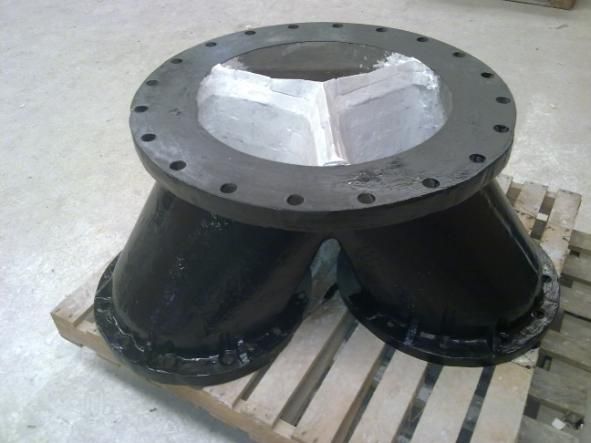
- T / Y branches — rectangular box outside, round profile inside, reinforced where attack is worst.
- Orifice plates — flow and pressure control with no erosion of the calibrated bore.
- Custom linings — ducts, chutes, valves and burner blocks.
Material: CT CEDUR alumina
Steel-industry components use the CT CEDUR line — technical alumina sintered above 1,600 °C, virtually free of glassy phase, retaining hardness and structural integrity at high service temperatures. For abrasion with particulate impact, the CT CEDUR 96HH formulation; for purity requirements and complex parts, 99HH.
FAQFrequently asked questions
Can ceramic withstand steelmaking temperatures?
Yes. CT CEDUR alumina is sintered above 1,600 °C — in in-house kilns reaching 1,750 °C — and retains its mechanical properties at high service temperatures, with no deformation or loss of structural integrity.
How does ceramic prevent holes in elbows and branches?
CETARCH branches have a round, continuous internal profile with no weak points at the joints, and are reinforced where the flow attacks hardest. With hardness above 1,300 HV, the ceramic wall does not groove like metal — the classic hole point disappears.
Do you make parts for existing equipment?
Yes. Every part is custom-made from the drawing or a reference part — pipes, branches, plates and burner blocks are built to match the original equipment, without changing the process.