For most industrial applications, the alumina grade is chosen by the duty, not by the number: pure, severe abrasion calls for CT CEDUR 94HH; abrasion combined with impact calls for 96HH; aggressive chemical attack, high purity or thin, complex parts call for 99HH; and standard lining, at the best cost, is CT CEDUR 90 territory. The material’s general trend explains why: the higher the Al₂O₃ content, in general, the higher the hardness, density and chemical inertness — and the cost. The whole CT CEDUR line works in the range of 9 Mohs and 1,300-1,600 HV, sintered above 1,600 °C with virtually no glassy matrix. When in doubt, CETARCH engineering specifies the formulation from an analysis of your flow.
Why the Al₂O₃ content matters
The "grade" of an alumina is its aluminium oxide (Al₂O₃) content in the sintered technical ceramic — the rest is sintering additives and grain-boundary phases. That number became the market’s commercial shorthand: 92, 94, 96, 99. And it matters because, as a general trend, the higher the alumina content, the higher the material’s hardness, density and chemical inertness — and the higher the cost as well.
But the content is only the starting point: raw material, milling and the sintering curve weigh as much as the number on the label. In the CT CEDUR line, which runs from 90 to 99HH, the Al₂O₃ content spans 90% to 99.5% and the whole line is sintered above 1,600 °C, virtually free of glassy matrix — it is that combination, not the number alone, that sustains the line’s 9 Mohs and 1,300-1,600 HV hardness.
What changes in practice as the content rises
Manufacturers’ datasheets and the advanced-ceramics literature point to the same general trends — always comparing well-sintered materials with each other:
- Hardness and wear resistance — generally rise with the alumina content: more hard crystalline phase and less grain-boundary phase, which is where wear advances first.
- Density — tends to rise with the content, and the final density is a good indicator of well-executed sintering: a pore is a weak point against abrasion.
- Chemical inertness — sintering additives form glassy phases at the grain boundaries, and that is where acids and alkalis usually attack first; the higher the purity (and the smaller the glassy matrix), the higher the chemical resistance and the lower the risk of contaminating the product.
- Cost — rises with purity: nobler raw material and a more demanding process. Paying for 99% where 94% does the job is waste; saving where chemistry attacks the grain boundary gets expensive.
Which grade for which duty: 94HH, 96HH or 99HH
In the CT CEDUR line, the choice follows the equipment’s wear regime — the same logic behind every wear-resistant ceramic lining:
- Pure, severe abrasion → CT CEDUR 94HH — slurries, powders and particulates in continuous flow: the typical case of cyclones and slurry pumps.
- Abrasion with impact → CT CEDUR 96HH — large particles, impact points, crushing: the formulation developed for severe abrasion and impact.
- Chemical attack or high purity → CT CEDUR 99HH — aggressive acids and alkalis, contamination-sensitive processes, thin parts and complex geometries.
| Duty | Indicated formulation | Why |
|---|---|---|
| Standard lining, with chemical attack | CT CEDUR 90 | High hardness and chemical resistance at the best cost |
| Pure, severe abrasion | CT CEDUR 94HH | The line’s high-abrasion formulation |
| Abrasion combined with impact | CT CEDUR 96HH | Developed for severe abrasion and impact |
| Aggressive chemical attack · high purity | CT CEDUR 99HH | High purity for aggressive chemistry and thin or complex parts |
// Initial guidance by duty — the final specification considers flow, temperature, chemistry and part geometry.
How to specify: the duty decides, not the number
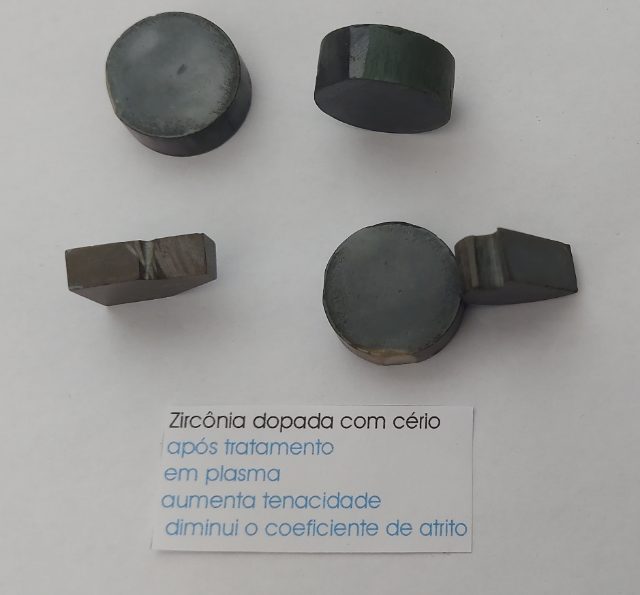
Two suppliers can sell "95% alumina" with very different performance — raw material, milling, pressing and firing curve do not show on the label. That is why serious specification starts from the duty, not the number: what flows (material, particle size, particle hardness), at what velocity, with which chemistry and temperature, and in which part geometry. And when the process demands properties beyond alumina, doped-zirconia and rare-earth compositions come in, on demand.
In practice, you do not need to arrive with the grade ready. Parts are custom-made to match the original equipment’s geometry, and CETARCH engineering specifies the formulation from an analysis of your flow — from 90 to 99HH, with the line’s hardness between 1,300 and 1,600 HV.
FAQFrequently asked questions about alumina grades
Is 99% alumina always better than 92 or 94%?
No. In general, higher content brings more hardness, density and chemical inertness — but also more cost. For pure abrasion, a high-abrasion formulation like CT CEDUR 94HH is the balance point; 99HH pays off when there is aggressive chemical attack, a purity requirement, or thin and complex parts.
What changes between CT CEDUR 94HH, 96HH and 99HH?
The duty indication: 94HH for high abrasion; 96HH for abrasion combined with impact; 99HH for high purity and chemical attack. The whole line works in the range of 9 Mohs and 1,300-1,600 HV, sintered above 1,600 °C with virtually no glassy matrix.
Why does higher-purity alumina resist chemical attack better?
Because attack by acids and alkalis generally concentrates on the glassy grain-boundary phases formed by sintering additives. The higher the purity — and the smaller the glassy matrix — the fewer points of attack. That is why 99HH is indicated for aggressive chemistry and contamination-sensitive processes.
Do I need to know the grade before requesting a quote?
No. Describe the duty — conveyed material, particle size, velocity, temperature, chemistry and the part that wears — and CETARCH engineering specifies the formulation from an analysis of your flow, with parts custom-made.