The elbow fails first because that is where the abrasive flow changes direction and concentrates the entire attack on a single point — in slurry pipelines, pulp lines and pneumatic conveying. Thicker walls or rotating the elbow only postpone the replacement. The definitive fix is lining the elbow with CT CEDUR alumina ceramic (9 Mohs, over 1,300 HV): up to 10 times the service life of the metal elbow at the same point, with the internal profile preserved — no flow restriction — matching the pipe and flange dimensions of the existing metal line, with no repiping needed.
Why the elbow always fails first
In the straight run, particles travel almost parallel to the wall — wear is distributed and slow. At the elbow, the flow is forced to change direction: slurry, powder or grain keeps going straight by inertia and slams into the outer radius (the extrados) of the bend. All the impact and erosion energy the straight line dilutes, the elbow concentrates into a few square centimetres. That is why the hole always appears in the same place — and always at the elbow, never in the straight pipe next to it.
The symptoms are familiar to any maintenance team: the same elbow replaced at every shutdown, the hole in the extrados, the extra wall thickness that lasts a little longer and wears through all the same, pneumatic conveying eating ash and coal elbows, the slurry line that always leaks at the bend.
The usual quick fixes — and why they only postpone
- Thicker walls — more material to wear through takes longer to fail, but the wear rate stays the same. The replacement cycle stretches; it does not end.
- Rotating the elbow — exposes a fresh region to attack and reuses the part once or twice. Recurring labour to postpone the inevitable.
- Hardfacing weld overlay — restores the surface, but the deposit wears too, needs a shutdown to apply and changes the internal roughness.
All three attack the consequence (a thin wall), not the cause (a metal surface that cannot resist concentrated abrasion). As long as the contact surface is metal, the replace-wear-replace cycle continues.
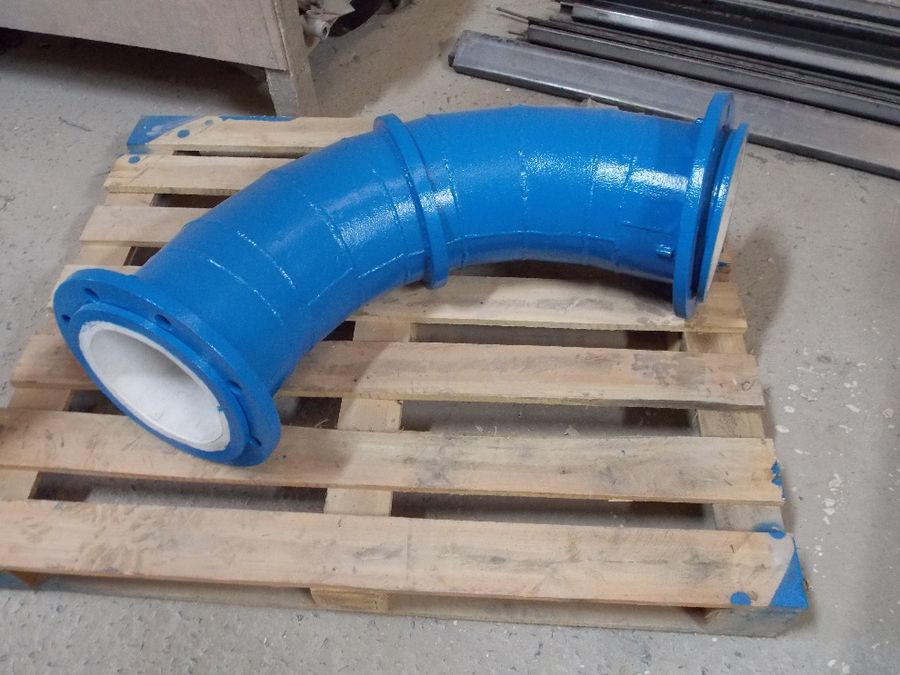
The definitive solution: a ceramic-lined elbow
A CT CEDUR ceramic-lined elbow changes the sacrificial surface: instead of metal, technical alumina at 9 Mohs and over 1,300 HV — a hardness level the abrasive flow can barely scratch. The field result is up to 10 times the service life of the metal elbow at the same point, with the internal profile preserved (no flow restriction) and a low-roughness surface that improves flow.
And because pipe and flange come in the same sizes as the original assembly, installation is a direct swap into the existing line. The same applies to the line’s other critical points: T and Y branches (rectangular outside, round profile inside, no weak points) and solid-ceramic multi-outlet distributors.
Where this pain is worst
- Thermal power plants — pneumatic conveying of pulverized coal and ash: elbows are the most replaced part in the plant.
- Mining — slurry lines: a leaking bend is unplanned downtime.
- Agribusiness — grain, feed and fertilizers wear out pneumatic-conveying elbows and branches.
Frequently asked questions about ceramic elbows
Can I install a ceramic elbow in my existing piping?
Yes. Lined pipes and elbows come with pipe and flange in the same sizes as the original metal assembly — installation is a direct swap, with no line adaptation and no process change.
What about impact from large particles?
For abrasion combined with impact there is the CT CEDUR 96HH formulation, developed for severe abrasion and impact. CETARCH engineering specifies the formulation from an analysis of your flow — conveyed material, velocity and particle size.
How long does a ceramic-lined elbow last?
The field benchmark is up to 10 times the service life of the metal elbow at the same point. In lines where the elbow was replaced at every shutdown, it starts lasting through several maintenance cycles.
Does the ceramic reduce the bore or restrict flow?
No. The parts match the original equipment geometry, with no reduction of flow areas. The ceramic surface also has lower roughness than worn metal, which helps flow.