It depends on the wear regime. If the part is structural, takes heavy impact or bending, or must be welded in the field, wear steel remains the right choice. Under continuous sliding abrasion, however, the decision is arithmetic: AR400 plate runs at 360-440 HB and AR500 around 460-540 HB — in Vickers, roughly 400 to 550 HV. CT CEDUR alumina reaches 9 Mohs and 1,300-1,600 HV: about three times the hardness of the hardest plate, above the hardness of the abrasive itself. The field result is up to 10× the service life, with the design geometry preserved. And the dominant solution is the hybrid — steel in the structure, ceramic on the sacrificial surface. Bottom line: for continuous sliding abrasion, ceramic is the choice.
Why AR plate became the standard — and where it is still right
Wear steel is a quenched and tempered steel supplied as plate and classified by Brinell hardness: the AR400 family runs in the 360-440 HB range and AR500 around 460-540 HB — like the AR plates well known in the market. The reasons for its popularity are real: the plate is weldable, cuts and rolls in the fab shop, resists impact and bending without cracking and serves a structural function. In buckets, cutting edges and drop points hit by large rock, it remains the right choice.
The limit shows up in continuous sliding abrasion — slurry, powder or grain running over the same surface, hour after hour. Moving from AR400 to AR500 buys weeks but does not change the mechanism: the steel scale ends around 550 HB, and quartz, the most common industrial abrasive, is harder than any plate. When the particle beats the surface, wear runs in the severe regime — and the plate becomes a recurring line on the purchase list.
Where ceramic wins: sliding abrasion
The deciding comparison is not between metals — it is against the abrasive. In Vickers, AR plates sit roughly between 400 and 550 HV; the quartz in ore, sand and ash exceeds 1,000 HV and scratches any steel. CT CEDUR alumina technical ceramics, sintered above 1,600 °C, reach 9 Mohs and 1,300-1,600 HV: the surface becomes harder than the particle, and wear changes regime. That is the basis of the wear-resistant ceramic lining — and of the benchmark of up to 10× the service life of metal at the same point.
- Hardness above the abrasive — when the surface is harder than the particle, deep gouging turns into polishing: the difference between replacing plate at every shutdown and lasting through entire cycles.
- Preserved geometry — plate thins and changes profile, altering flow and jet; the ceramic part keeps the design shape to the end of its life.
- Hardness that is not lost — the AR plate’s comes from quenching and degrades with welding, thermal cutting and hot service; the alumina’s belongs to the material itself, stable at process temperatures.
- Lower cost per operating hour — ceramic costs more to buy; fewer stoppages, less fab-shop work and fewer replacements flip the equation within the first cycle.
Side-by-side comparison
| Criterion | AR steel (AR400/AR500) | CT CEDUR |
|---|---|---|
| Hardness | 360-440 HB (AR400) · 460-540 HB (AR500) ≈ 400-550 HV | 9 Mohs · 1300-1600 HV — above quartz |
| Impact and bending | Strong point — tough, deforms without breaking | Brittle under direct impact — needs the right design and formulation (96HH) |
| Weldability | Field-weldable, with local hardness loss | Cannot be welded — bonded, bolted or fixed via weldable backing |
| Geometry over the service life | Thins and progressively changes profile | Stable — keeps the design shape |
| Service temperature | Loses quench hardness in hot service | Sintered above 1,600 °C — stable at process temperatures |
| Weight | ≈7.85 g/cm³ | ≈3.7 g/cm³ — less than half the weight |
| Life in severe sliding abrasion | Baseline (1×) | Up to 10× at the same wear point |
The best of both: steel in the structure, ceramic on the surface
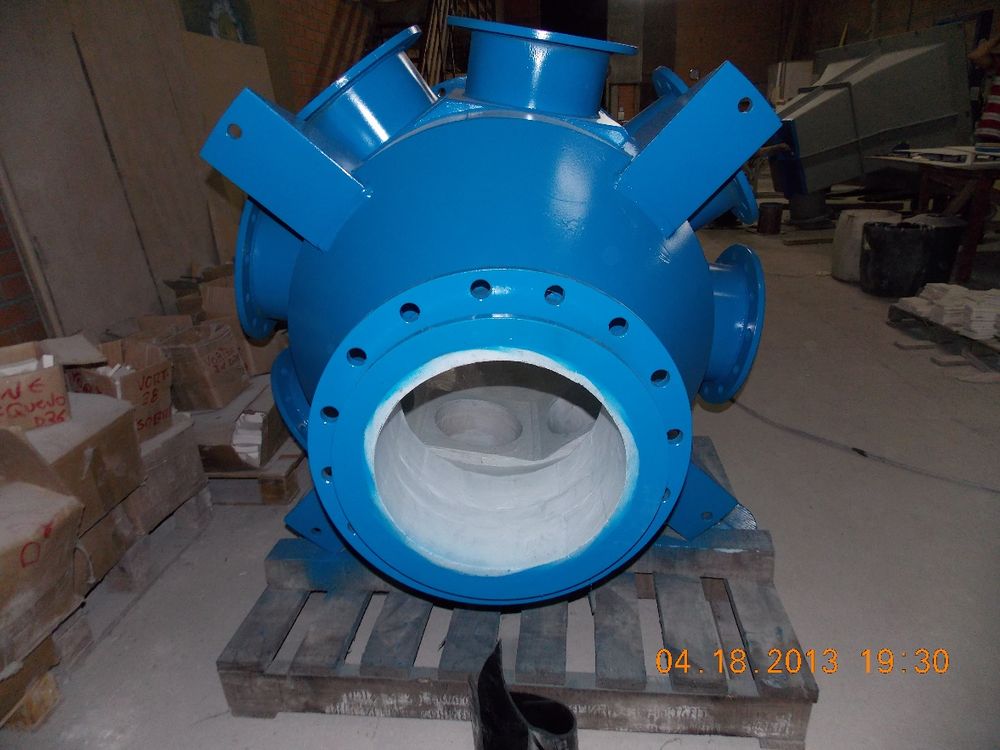
In market practice you almost never have to choose: steel provides the structure, shell and flanges; ceramic takes over the surface in contact with the abrasive flow as a sacrificial layer — bonded or bolted tiles, panels with weldable metal backing and custom-moulded parts. It is the standard in pipe elbows and critical piping points and in severe environments such as the steel industry — the equipment stays the same; only the surface changes material.
How to decide — in three questions
- What is the wear regime? — heavy impact, bending or structural function: stay with steel. Continuous sliding of slurry, powder or grain: ceramic. If the current part is cast iron, see the Ni-Hard vs ceramic comparison.
- Does the part need field welding? — ceramic cannot be welded, but panels with metal backing and weldable supports solve the assembly. CETARCH manufactures to measure in Criciúma/SC, Brazil, from your drawing or a reference part.
- Where does the bill hurt most? — start at the point that consumes plate at every shutdown: that is where the up-to-10× gain shows first and pays for the project.
Verdict: each material in its place — and ceramic at the wear point
The verdict is straightforward: AR steel is structure; ceramic is the definitive sacrificial surface. In the typical published ranges, AR plate sits on the order of 400-550 HV, while CT CEDUR alumina operates at 1,300-1,600 HV and 9 Mohs — a hardness class steel simply does not reach. Under continuous sliding abrasion, the ceramic part lasts up to 10× longer, keeps the design geometry — steel “thins” and loses its profile — and does away with the endless cycle of welding and plate replacement. In practice the winning combination is one: a steel structure with a CETARCH ceramic lining at the wear point.
If one point of your plant consumes plate at every shutdown, that is the place to start: see the CT CEDUR ceramic wear plates — custom-made in Criciúma/SC, Brazil — and request a quote from your drawing or a reference part.
FAQFrequently asked questions: wear steel vs ceramic
What is the real hardness gap between AR500 and ceramic?
AR500 plate runs around 460-540 HB — in the 500-550 HV range. CT CEDUR alumina reaches 1,300-1,600 HV and 9 Mohs: about three times the hardest plate, above the hardness of quartz, the most common abrasive. That inversion — surface harder than the abrasive — explains the up-to-10× service life in abrasion.
Does ceramic replace structural steel?
No. Ceramic is a surface material, not a structural one: it does not work in bending nor absorb impact like steel. The solution is the hybrid — structure in steel, contact layer in ceramic: steel delivers the mechanical strength; ceramic, the wear resistance.
How is ceramic fixed, if it cannot be welded?
By structural bonding, bolting, or panels with a metal backing that welds to the equipment. The parts are custom-made to match the original geometry — a lining swap, not a new plant design.
When should I stay with AR plate?
When the part is structural, takes heavy impact from large particles, works in bending or needs field weld repairs. In those regimes steel defends itself best — ceramic comes in on the continuous-sliding stretches where the plate has become a consumable. For abrasion with moderate impact there is CT CEDUR 96HH.