Ni-Hard is the trade designation of a family of white cast irons alloyed with nickel and chromium, classified under ASTM A532 (Class I, types A to D — Ni-Hard 1 to 4). Nickel, typically between 3 and 5%, ensures a hard martensitic matrix; chromium forms even harder carbides dispersed in that matrix. The result is a metal with hardness typically between 500 and 600 HB, among the highest abrasion resistances of metallic materials. That is why Ni-Hard became the historical standard in slurry pumps, mill liners, crushers, pipe elbows and cyclones. Its limitations are brittleness (low resistance to tension and impact), very difficult machining, and progressive wear that changes the geometry of the part. Under continuous abrasion, technical alumina ceramic replaces it and lasts up to 10 times longer at the same wear point.
What Ni-Hard is: definition and origin
Ni-Hard is the trade name — today practically a generic industry term — of a family of white cast irons alloyed with nickel and chromium, developed to resist abrasive wear. “White” describes the fracture: since virtually all the carbon is combined into carbides rather than free graphite, the fracture surface is light-coloured. It is these carbides, dispersed in a martensitic matrix, that give the material its defining trait: high hardness and one of the best abrasion resistances among metals.
With decades of proven industrial use, Ni-Hard became the historical standard against wear in mining, cement, steel and sanitation. It is cast into complex geometries — pump casings, liners, hammers, elbows — and delivered heat-treated, ready to work in direct contact with abrasive flows.
Composition and grades: what ASTM A532 says
The ASTM A532 standard organises abrasion-resistant white cast irons into classes. The Ni-Hards form Class I: nickel-chromium alloys with typically 3 to 5% nickel and 1 to 4% chromium — except Ni-Hard 4, which rises to the 7 to 11% chromium range. In practice, the market knows types A, B, C and D by their established names:
- Ni-Hard 1 and 2 (types A and B) — the most common and economical of the family. They differ mainly in carbon content: type 1, harder, for predominantly abrasive service; type 2, slightly tougher, for moderate dynamic loading.
- Ni-Hard 3 (type C) — a composition adjusted for specific parts, such as cast grinding media.
- Ni-Hard 4 (type D) — more nickel (on the order of 5 to 7%) and much more chromium (7 to 11%). The carbides change type and become discontinuous, which improves resistance to fracture under repeated impact — it is the choice for severe duty, such as slurry pump volutes.
Why Ni-Hard is hard: martensite + carbides
The metallurgical recipe has two ingredients. Nickel delays the transformation of austenite into pearlite during cooling in the mould, ensuring the matrix becomes martensitic — the hardest form of iron — in the as-cast state or after heat treatment. Chromium, in turn, combines with carbon to form carbides (of the M3C type in the classic Ni-Hards; of the harder, discontinuous M7C3 type in Ni-Hard 4) that act as a skeleton of extremely hard particles within that matrix.
The result is a Brinell hardness typically between 500 and 600 HB, one of the highest levels among engineering metals — and the reason Ni-Hard was, for decades, the natural answer to abrasive wear. For reference: converted to the Vickers scale, that range still sits well below the hardness of a technical alumina, and that gap explains much of the relative behaviour of the two materials under continuous abrasion.
Where Ni-Hard is used
The family was born for the most punished points of the process industries. Classic applications include:
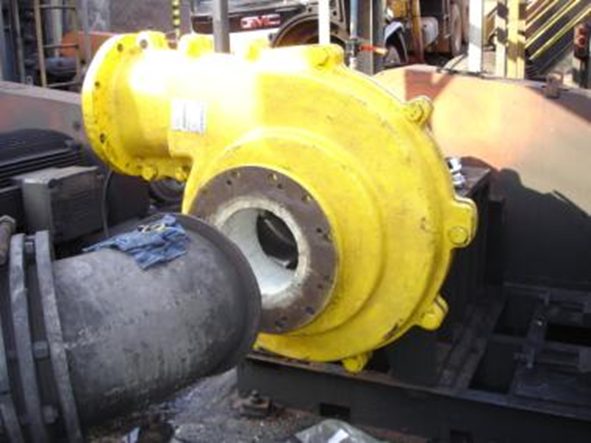
- Slurry pumps — casings, volutes and impellers in mining and dredging; today one of the most common migration points towards ceramic-lined pumps.
- Grinding and crushing — mill liners, grinding media, crusher hammers and jaws, pulveriser rolls.
- Abrasive conveying — elbows, piping, chutes and launders; pipe elbow wear is the typical case.
- Classification — cyclones and hydrocyclones, where the internal profile defines separation efficiency.
Engineering limitations
No material is good at everything — and the limitations of Ni-Hard are the exact flip side of its virtues. The same microstructure that provides hardness exacts a price:
- Brittleness — like all white irons, Ni-Hard is brittle: it resists compression well, but tension and concentrated impact poorly. It is not a structural material, and cracks can propagate without warning.
- Very limited machinability — at service hardness, finishing is done practically only by grinding. Holes, threads and fits must be designed into the casting.
- A profile that changes as it wears — Ni-Hard wears progressively; the part changes geometry long before it wears through, and a cyclone or volute out of profile loses process efficiency.
- Sensitivity to thermal shock and corrosion — sudden temperature swings can crack the material, and in acidic or alkaline media the alloy suffers abrasion and corrosion at the same time.
When replacing it with technical ceramics makes sense
“Historical standard” does not mean “best option in every regime”. Under continuous abrasion from slurries, powders and grain — the regime that dominates the process industries — alumina technical ceramics operate on another level of hardness: the CT CEDUR line reaches 9 Mohs and 1,300-1,600 HV, with up to 10 times the service life of Ni-Hard at the same wear point and geometry preserved to the end of the part’s life.
The typical migration keeps the metal structure and swaps only the sacrificial surface for a wear-resistant ceramic lining. For the decision criteria — hardness, impact, geometry and cost per operating hour — see the full Ni-Hard vs ceramic comparison.
The natural successor to Ni-Hard in abrasion
Ni-Hard was the twentieth century’s standard against wear — but under continuous abrasion it has a physical ceiling: the hardness a metal can reach. Alumina technical ceramic operates in another class — 9 Mohs and 1,300-1,600 HV, a level no metallic alloy reaches — and therefore lasts up to 10 times longer at the same wear point, keeping the geometry that Ni-Hard loses as it wears. If your Ni-Hard part has become a recurring replacement item, that is the upgrade signal.
To weigh hardness, impact, geometry and cost per operating hour, see the full comparison — or bring your case straight to CETARCH’s engineering team.
FAQFrequently asked questions
Is Ni-Hard a type of steel?
No. Ni-Hard is a white cast iron — an iron-carbon alloy with a much higher carbon content than steels, in which the carbon is combined into hard carbides instead of graphite. That is what makes it far more abrasion-resistant than ordinary steels, and also more brittle.
What is the hardness of Ni-Hard?
Published ranges for the family typically sit between 500 and 600 HB (Brinell), varying with the grade, section thickness and heat treatment. It is one of the highest levels among engineering metals — yet still well below the hardness of technical alumina ceramics, which in the CT CEDUR line reach 1,300-1,600 HV.
What is the difference between Ni-Hard 1 and Ni-Hard 4?
Ni-Hard 1 (ASTM A532 Class I, type A) is the most common and economical, with typically 3 to 5% nickel and 1 to 4% chromium. Ni-Hard 4 (type D) carries more nickel and 7 to 11% chromium, forming discontinuous carbides that improve resistance to fracture under repeated impact — which is why it is used in the most severe duties, such as slurry pump volutes.
When is it worth replacing Ni-Hard with ceramic?
When the dominant regime is continuous abrasion and the same part goes back on the purchase list at every shutdown. In that scenario, alumina ceramic lasts up to 10 times longer at the same point and keeps the design geometry. Under extreme point impact, metal still defends itself better. The full Ni-Hard vs ceramic comparison details the decision criteria.